
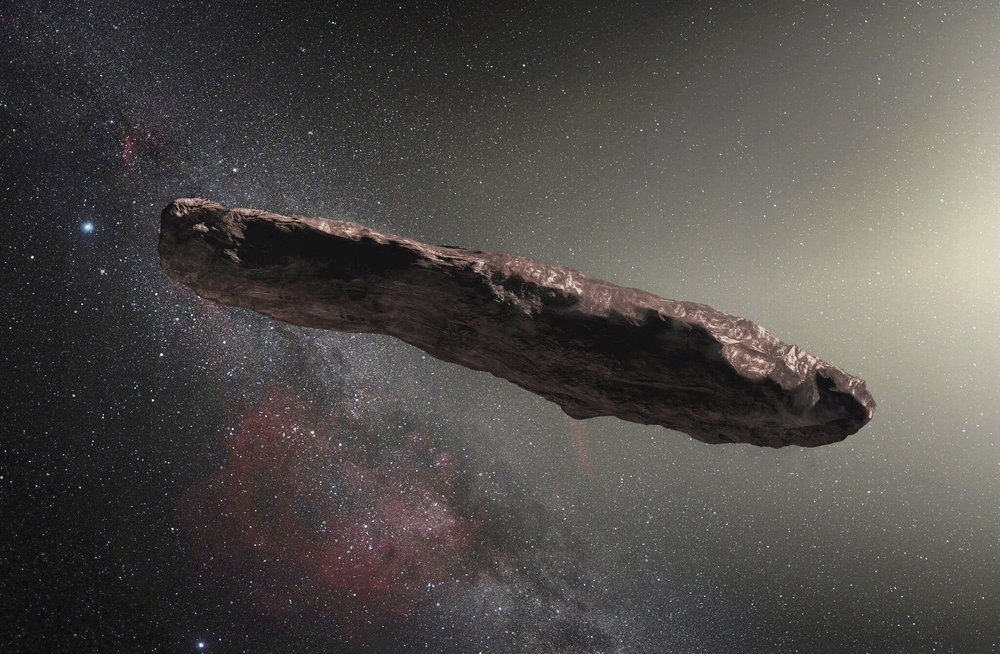
Are there extraterrestrial civilisations? Have they visited us? Are UFOs of extraterrestrial origin? Many people are convinced that we have been visited by aliens time and again. It is reasonable to harbour doubts about such ideas.
UFO = Extraterrestrial?
A UFO (Unidentified Flying Object) is, by definition¹, an unidentifiable flying object which, due to the lack of identification, is usually attributed to an extraterrestrial origin. UFO observers practically expect this extraterrestrial origin. It almost automatically becomes the hypothesis, and their perception is steered towards confirming the hypothesis². Observers tend, for example, to recognise features that cannot be of terrestrial origin and to ignore features that would explain a terrestrial origin.
An extraterrestrial origin has never been proven. Consequently, the origin of the observed UFOs was either not extraterrestrial, or the quality of the observation was insufficient to provide proof. We are in the dark when it comes to the question of extraterrestrial origin. UFO sightings are currently investigated in the USA by both civilian and military authorities, which is why I would like to rule out conspiracy theories.
Note: The new official term for UFO is UAP (unidentified aerial phenomena)
Characteristics and quality of the observations
When it comes to accounts of UFOs, one must rely on the credibility of the observer reporting them. When similar sightings become more frequent, one investigates the reasons for their similarity. This leads to the conclusion that the similarity of the sightings can be attributed to a comparable background of experience amongst the observers. For example: the UFOs observed resemble the spaceships in popular science fiction films. In the 1950s, UFO sightings mostly described rotating flying saucers, as depicted in the cinema at the time. In the decades that followed, the shape changed, but always in striking accordance with current cinema and television films.
Visual evidence has increased significantly since the 1950s, as nowadays everyone carries a smartphone and thus has a high-quality camera and a high-resolution video camera at their disposal. Although almost all observers know how to use them, it is striking that UFO photographs and videos are shaky and out of focus, making it impossible to draw any clear conclusions. The great distance and the element of surprise are usually cited as the reasons for the poor image quality, as it is virtually impossible to take poor-quality photos or videos with a smartphone.
Apart from weather phenomena, the UFOs observed usually resemble flying objects whose flight characteristics appear unnatural or ‘otherworldly’ at first glance. For example: extremely rapid changes of direction that no normal pilot could withstand.
UFO sightings are increasingly resembling drones, the use of which has grown both in professional applications and as a hobby. It therefore stands to reason that drones are inadvertently being mistaken for UFOs.
Even sightings by professionals, such as airline pilots, fighter pilots or astronauts, have so far not been identified as extraterrestrial. In most cases, a natural, terrestrial origin is identified. For example, faulty radar or sensor readings. The reason for the greater accuracy in establishing the truth in professional sightings is the obligation to report them and the systematic analysis carried out.
Last but not least, many sightings are hoaxes.
According to an article in the NZZ from June 2023, both NASA and the Pentagon have expressed difficulty in explaining the sightings under investigation. Of the 800 recorded sightings of UAPs (unidentified aerial phenomena) investigated by the military (the Pentagon), only a small percentage remain (as yet) unexplained. The vast majority of sightings had mundane causes. NASA is investigating sightings reported by members of the public and has reached a sobering, preliminary conclusion: ‘The available data and eyewitness accounts alone are insufficient to provide conclusive evidence regarding the nature and origin of each UAP incident.’
Interstellar Journey to Earth
If, despite the lack of evidence to date for extraterrestrial beings in flying objects, one assumes that they do exist, then one must consider their capabilities and motives. What must they want and be capable of in order to reach us?
The laws of physics are the same throughout our galaxy and the observable universe, as they have so far been confirmed by all observations. For example, it has been proven that nothing can travel faster than light (photons) (1,080,000,000 km/h). Even with technology far more advanced than our own, one could travel through space at no more than a fraction of the speed of light³. The reason for this is relative mass, which increases in proportion to the square of velocity. Interstellar travel takes a great deal of time – centuries, millennia and much longer still. We are faced with a severe limitation on travel.
If a spacecraft could travel at 10 per cent of the speed of light – a figure that seems utopian to us – then in a thousand years it could cover a distance of 100 light-years, or 946 trillion kilometres. That sounds like a lot, but it is very little, because our Milky Way alone – a barred spiral galaxy – has a diameter of 82,000 to 90,000 light-years⁴. After a thousand years’ journey, the aliens would therefore have covered one thousandth of the diameter. They could hardly have come from very far away, then, if they were here.
This then raises the question of resources and also the life expectancy of our UFO pilots: fuel and food for thousands of years? Technology that never fails? Organisms that live much longer than we do?
Even if all that were possible and they actually managed to find our planet (!), what then? Would they hurtle aimlessly through our atmosphere so that we could observe them, or would they suddenly vanish again, just as they had arrived, without making contact with us or leaving any traces? Or would they first want to observe Earth and then communicate back home, using electromagnetic waves that cannot travel faster than the speed of light?
We know far more than we are capable of. But even a civilisation far more capable than us, one that is technologically far more advanced, would be hardly in a position to visit us within a ‘reasonable timeframe’; and even if they could, it would hardly be with the sole aim of being observed by us as a UFO. They would be impossible to miss if they were here.
The quest for certainty
Most enlightened people are convinced that, alongside us, there are, have been, or will be many civilisations in the universe⁵. The sheer scale of things leaves little room for any other conclusion. The unimaginably vast number of galaxies, stars/suns, planets and moons – as well as their age – defies any notion that the emergence of life and its evolution into civilisations comparable to our own could be limited in any way. Out there, everything is simply far too vast to allow us to restrict or rule out anything.
Life forms on another planet might possess completely different DNA, or something entirely different from DNA, meaning they would be incomparable to anything known to us. If they are intelligent, their intelligence would not be comparable to ours. Their motives and behaviour would bear no relation to our own motives and behaviour.
However, the sheer scale of the universe withstands even the even slimmer probability that there are, or were, extraterrestrial civilisations that are, or once were, quite similar to us. Even when a chain of many conditions is taken into account, there is still a considerable number of possibilities, spread geographically across the entire universe.
When it comes to the assumption or presumed certainty that extraterrestrials have either been here, are here, or keep turning up, we are guided far too strongly by the urgent desire for an encounter. We long for the certainty that we are not the only ones and that we are not alone in the universe. This desire for interstellar company is a little childish and brings to mind E.T., who really did need to phone home urgently.
The scientific search for extraterrestrial life is in full swing, quite apart from UFO sightings, which science probably finds rather annoying. Since a visit to Earth by extraterrestrial beings would be unlikely to go unnoticed, astronomers can confidently concentrate on tracking down signs of life, initially within our solar system, and on finding exoplanets where the existence of life forms might be possible. The focus here is not initially on civilisations, but on the simplest forms of life. Their discovery anywhere in our solar system would already be a sensation, even if only fossilised evidence of past life were to be found – for example, microbes on Mars⁶.
Time
There are three possible temporal scenarios: an extraterrestrial civilisation exists at the same time as us, it existed long before us, or it will only exist in the distant future.
We may encounter a contemporary extraterrestrial civilisation, albeit with a very low probability. Here or there, the only opportunity for a ‘handshake’ would arise.
A past extraterrestrial civilisation would be easier to find if its remnants were drifting through space and happened to come near our solar system. Extraterrestrial fossils could bear witness to a past civilisation for billions of years. This makes it more likely that a civilisation like ours might ever take notice of them. By way of comparison: we know a great deal about the dinosaurs, even though no one has ever laid eyes on a living specimen.
A future – as yet non-existent – extraterrestrial civilisation is of no significance to us, because we ourselves will no longer exist.
Furthermore, there are theories suggesting that an extraterrestrial civilisation visited Earth thousands of years ago and, for example, laid the foundations for early advanced civilisations such as those of the Egyptians or the Mayans. Erich von Däniken has written many books on this subject. But this is science fiction: our genome is so closely related to that of Earthly organisms – which have existed for far longer than we humans have – that an extraterrestrial influence can be ruled out, as such influences could be detected.
Although a ‘handshake’ with an extraterrestrial promises the greatest excitement and adventure, it is far more likely that we will come across the remains of past civilisations or organisms.
Evolution does not proceed in a linear fashion
Since time immemorial, we have believed that we humans are at the pinnacle of evolution and, before we understood evolution, at the pinnacle of creation. This is true, insofar as we take our intelligence as the yardstick. Evolution, however, is a mechanism that ensures the survival of organisms. Whilst this mechanism has, over the course of 2 billion years, produced increasingly complex organisms, simple organisms are still vastly outnumbered. There are an unimaginably greater number of bacteria on Earth than there are humans. Their adaptability far surpasses our own. Life is impossible without them. One could certainly describe them as the pinnacle of evolution if adaptability were taken as the yardstick.
There are also animals that have hardly changed over a long period of time. Crocodiles⁷ or sharks, for example. Apart from their size, they differ – when compared with fossils – hardly at all from their ancestors, from the time when dinosaurs roamed the Earth. Despite their long evolutionary history, they have not become any more intelligent.
Thanks to the extinction of the dinosaurs, caused by an asteroid impact 66 million years ago⁸, mammals were able to evolve into the dominant species – and with them, humans. Without that catastrophe, we would not exist. We therefore owe our existence to an interstellar coincidence. Even without the accidental product that is humankind, the Earth would still be teeming with a diversity of flora and fauna today, but there would probably be no species amongst them that would seek to engage with extraterrestrial matters.
Evolution does not proceed in a linear fashion towards intelligent species. It is not enough for life to be possible on a planet for it to eventually give rise to an intelligent species and civilisation capable of interstellar travel. It requires the right evolutionary coincidence – or several of them together. Furthermore, such a species must survive long enough and not be wiped out by apocalyptic events – or wipe itself out.
There is evidence that five such events (mass extinctions⁹) have occurred in the history of our planet, some of which led to the extinction of up to 95 per cent of all life forms. The surviving species continued to evolve thereafter. If all goes well here on Earth, our planet will remain habitable for us humans for a further 600 million to, at most, 1.2 billion years¹⁰. After that, it will become too hot because the Sun is expanding more and more. We humans may have lived through perhaps two-thousandths of this time since the first hominids walked upright in search of food on the African savannah¹¹.
The question of perception
The concept of reality is relativised by the concept of perception. There is no single, unambiguous reality, but rather perceptions of realities, which presumably can differ far more greatly than we are accustomed to by earthly standards.
Our perception takes place through our senses: sight, hearing and touch. We perceive a limited spectrum of waves through our sensory organs. This encompasses temperature, light and sound. We have expanded the perceptible wave spectrum using helpful devices and technologies that we have invented. For example, we can make the infrared spectrum visible, we can perceive ultrasound, and we can detect and visualise electromagnetic waves. We have massively expanded our ability to understand the universe and, as a result, have made many discoveries in a short space of time.
If we imagine an extraterrestrial being with a perception entirely different from our own, it might be just as unable to perceive us as we are to perceive it. It would have a completely different conception of the same universe as we do. It could even be in the very same place as us without us realising it. In this respect, the notion of an encounter is put into perspective.
I consider this rather unlikely. The rocky planets known to us (with a solid surface, as opposed to gas giants) are very similar. On Mars, there is water ice and, presumably, microbes. Saturn’s moon Titan may, as is suspected, harbour an ocean beneath its icy surface. Perhaps an extraterrestrial primordial soup for all manner of life forms. The numerous exoplanets discovered so far are also chemically and physically comparable to the rocky planets in our solar system. In my view, it is more likely that life there could develop, or has developed, in a manner very similar to that on Earth. A biological similarity arises from the similarity of the habitat. That is why fish look relatively similar to one another.
Even here on Earth, interest in extraterrestrial matters ends at the next-lowest level of intelligence. Chimpanzees are very intelligent and very similar to us, but they have no interest in our solar system. Octopuses are also very intelligent, and whales communicate over long distances using a wide variety of sounds. Yet even they have no concept of life forms living outside their aquatic universe.
Fermi was probably wrong
I believe that Enrico Fermi – known for the Fermi paradox – assumed, when considering extraterrestrial civilisations, a linear course of evolution which, after no more than 5 billion years of a suitable planet’s existence, would ‘produce’ intelligent beings. That smacks a little of ‘creation’, of a plan.
He presumably assumed that older civilisations, such as our own, would almost automatically be far more advanced than we are, because they had had more time to develop. This assumption too – which I attribute to him – has the character of providence or divine guidance.
He generously assumed that, elsewhere, technology had solved all the problems that currently make interstellar travel impossible here on Earth. That is a bold assumption for a physicist.
He also seemed to assume that an extraterrestrial civilisation would, in any case, want to colonise the galaxy and expand. He presumably thought it was merely a matter of time before human-like beings spread out, just as we might do if we could and had to. He did not seem to consider that extraterrestrial civilisations might not feel any urge to expand, simply because they are not like us.
His assumptions have a fatalistic air about them.
The Fermi paradox is the term used to describe the conclusions reached by the physicist Enrico Fermi in 1950. Fermi assumed that extraterrestrial intelligence exists which is capable of sustaining technologically advanced civilisations over millions of years. Over such a period, it should theoretically be possible, by means of interstellar space travel, to colonise the entire galaxy – and, in all likelihood, this should already have happened. The fact that the search for traces of extraterrestrial life has so far proved unsuccessful struck him as paradoxical and as an indication that either the assumptions or the observations needed to be called into question.
Conclusion
Anyone who believes they glimpse extraterrestrial pilots in blurred images should – if they share my conviction – pause to consider how infinitesimal the chances are that such beings exist in the same cosmic moment as we do, that their trajectories might intersect ours, or that their motives would bear any resemblance to the human ones we so readily project outward. If extraterrestrial civilisations exist – and reason suggests they do – they inhabit some remote province of the universe, far from any galactic neighbourhood from which a journey to Earth would be conceivable, let alone meaningful.
Stephen Hawking adopted a more pragmatic stance. He thought contact possible and even suggested that discretion might serve us better than curiosity. Yet restraint is not a defining human virtue. So perhaps they will find us nonetheless. And then the question becomes not what they are, but what we are when confronted with the Other.
Christian Wenger (2021 to 2026)
Original in German. The original language is authoritative.
Sources in German:
1. UFOs: https://de.wikipedia.org/wiki/UFO
2. Hypothesis-driven perception: https://www.spektrum.de/lexikon/psychologie/hypothesengeleitete-wahrnehmung/6873
3. Speed of light: https://de.wikipedia.org/wiki/Lichtgeschwindigkeit
4. Milky Way: https://de.wikipedia.org/wiki/Milchstra%C3%9Fe
5. Observable universe, structure: https://de.wikipedia.org/wiki/Position_der_Erde_im_Universum
6. Microbes on Mars: https://www.deutschlandfunk.de/mikroben-auf-dem-mars-lebt-da-was.740.de.html?dram:article_id=491944
7. Crocodiles have existed for 200 million years. They have not changed significantly for 80 million years: https://www.br.de/wissen/krokodil-alligator-gavial-panzerechse-kaiman-100.html
8. Asteroid impact in the Yucatán: https://www.br.de/wissen/dinosaurier-asteroid-aussterben-dino-sterben-meteorit-114.html
9. Mass extinction: https://www.faz.net/aktuell/wissen/massenaussterben-fuenfmal-ging-die-welt-schon-unter-14424429.html
10. Life will continue to exist on Earth for another 600 million to 1.2 billion years:
11. The evolution of hominids: https://www.herder.de/geschichte-politik/vorgeschichte/die-evolution-der-hominiden/